Many watercourses within the Tweed catchment contain elevated levels of nitrates and phosphates, arising from sources such as agriculture, sewage systems, transport networks, mining and industrial activities. Excess nutrients can lead to significant environmental problems, including eutrophication, oxygen depletion, harmful algal blooms and a decline in biodiversity.
Budle Bay, a designated Site of Special Scientific Interest (SSSI) on the Northumberland coast, has experienced increasing algal growth linked to nutrient enrichment. The bay provides important feeding, breeding and resting habitat for a range of bird species, making it a priority location for the WADER project’s wetland interventions.
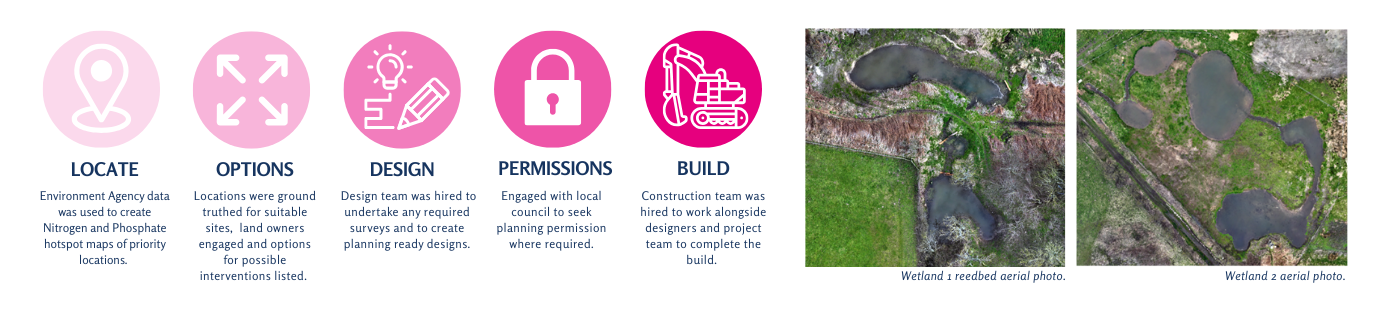
WADER collaborated with local farmers and land managers to install wetland systems around Budle Bay to help stem nutrient and sediment outflow into the watercourse. Wetlands and Sustainable Drainage Systems are simple and effective ways to improve water quality and biodiversity by tackling diffuse pollution. Wetlands have numerous environmental benefits as they filter and capture nutrients, slow water flow, store carbon, and create important habitats for wildlife- boosting biodiversity. The journey of wetland creation followed during the project is detailed below. The wetland designs were created by Blue Green Studios.
Wetland Site 1
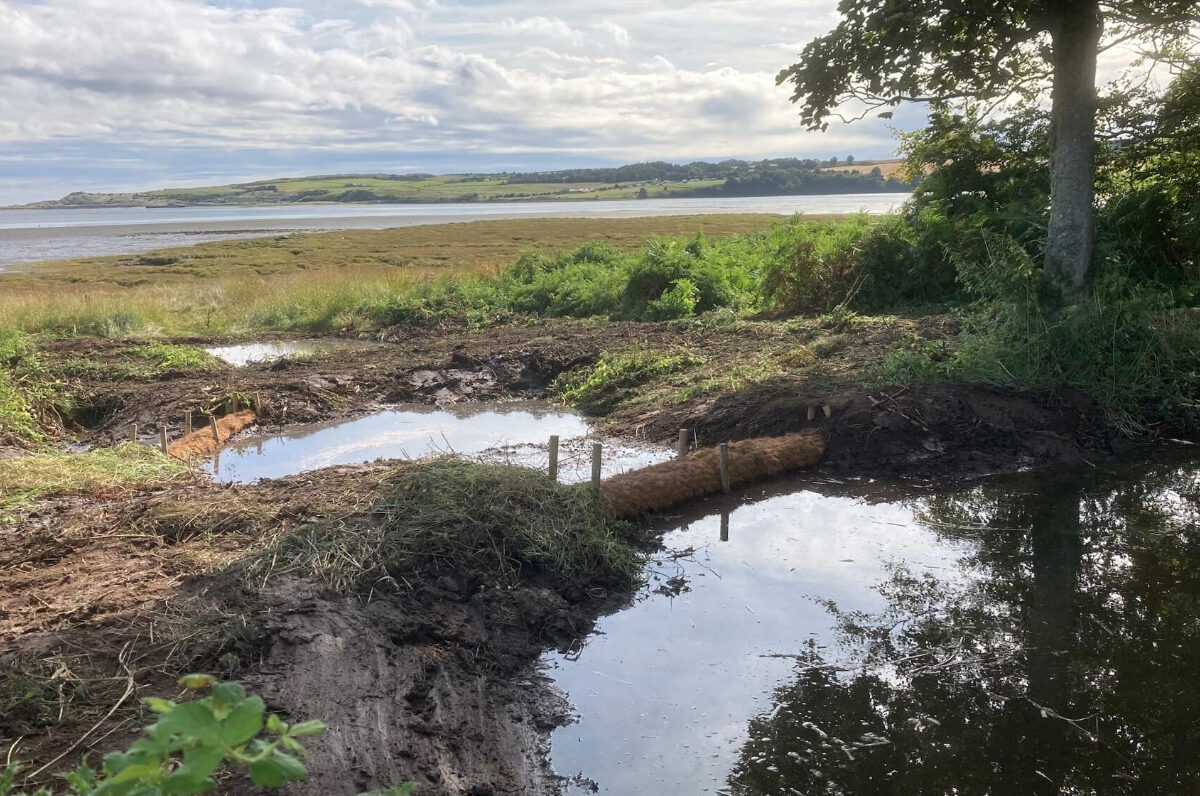
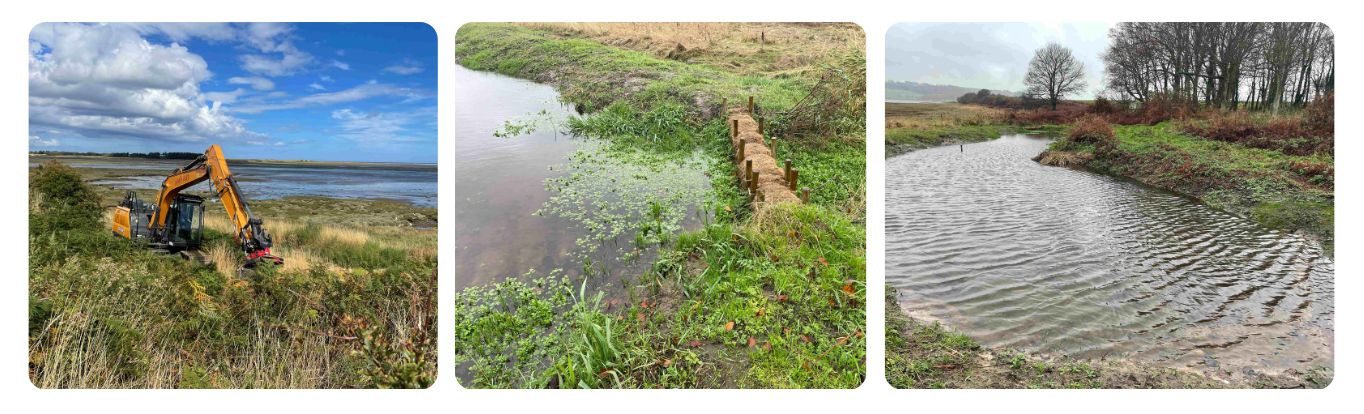
Site 1 is located within the Lindisfarne Site of Special Scientific Interest (SSSI), where agricultural drainage enters the Budle Bay saltmarsh. Due to the environmental sensitivity of the area, construction was confined to a narrow bracken-covered strip between the farmland and saltmarsh, and a series of small-scale interventions was selected to minimise disturbance.
A total of five wetland treatment systems, comprising ten ponds, were created. Four systems intercept field drains, while the fifth enhances an existing ditch and reedbed. The field-drain interventions consist of bunded settlement ponds fitted with coir-roll seepage barriers to slow flows and promote sediment capture. At the reedbed location, a multi-cell wetland system incorporating coir-roll barriers and a leaky dam was established to further improve water treatment and habitat diversity.
The largest intervention at this site is the reedbed enhancement, covering 0.03 hectares. In total, 0.07 hectares (725 m²) of new wetland habitat was created, providing additional capacity for water treatment while increasing the extent and diversity of wetland habitat within this protected landscape.
Wetland Site 2
Site 2 is situated on the eastern side of Budle Bay, immediately outside the Lindisfarne SSSI. The site intercepts a farmland drainage ditch that discharges directly into the bay. Algal growth observed at both historic and current outfall locations indicates a long-standing input of elevated nutrient levels.
The wetland receives runoff from the surrounding agricultural catchment, including flows from a precipitation-fed ditch, several field drains, and historic well connections. To improve water quality before discharge, a series of five asymmetric settlement ponds was constructed. The ponds are separated by coir-roll barriers and linked by stone-lined swales, which provide erosion control, encourage sediment deposition, increase aeration, and create surfaces for biofilm development.
Together, the wetland ponds cover 0.1 hectares (1,071 m²), significantly increasing water-storage capacity within the catchment. In addition to improving treatment of agricultural runoff, the scheme creates valuable freshwater habitat and enhances the biodiversity and conservation value of the wider Budle Bay landscape. 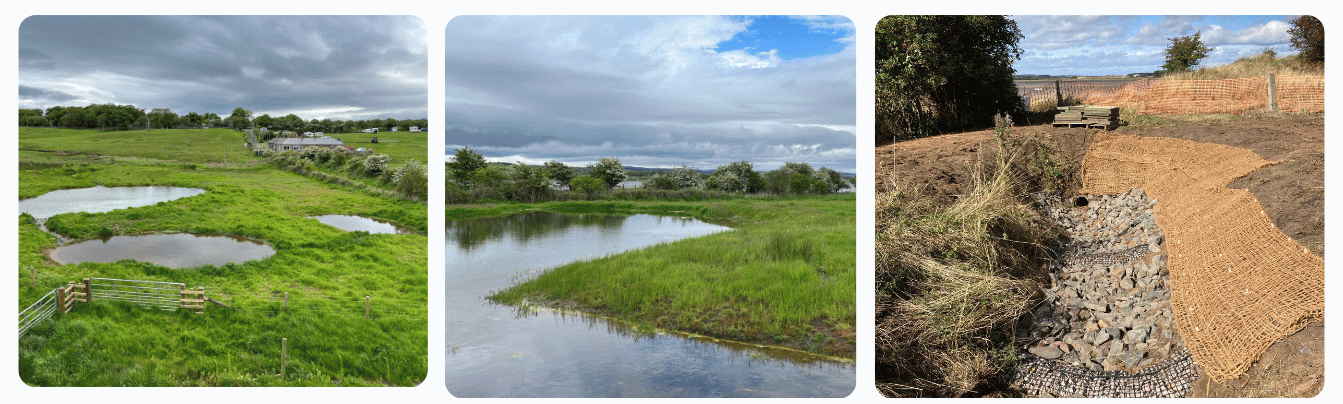
Agreements have been made with the Lindisfarne National Nature Reserve and landowners involved to maintain and protect the interventions for a minimum of 10 years.
At Wetland Site 1, the more established wetland is providing strong nutrient treatment performance, achieving an average reduction in nitrogen concentrations of approximately 25%, together with a modest decrease in phosphate levels. This performance is likely to reflect the maturity of the wetland system and the development of the biological and physical processes that support nutrient removal.
The newer Wetland Site 2 is delivering encouraging results, with average nitrogen concentrations reduced by approximately 3% between the inlet and outlet. Phosphate concentrations remained consistently low throughout the monitoring period, indicating effective nutrient management from the outset of the scheme. As the wetland matures and vegetation becomes more established, treatment performance is expected to improve further as biological and physical nutrient-removal processes develop over time.
Collectively, these findings demonstrate that both wetlands are helping to improve the quality of water leaving agricultural land before it enters local watercourses and coastal habitats. In addition to their water treatment function, the wetlands provide wider environmental benefits, including the creation of freshwater habitat, increased biodiversity, and improved ecological resilience across the landscape.
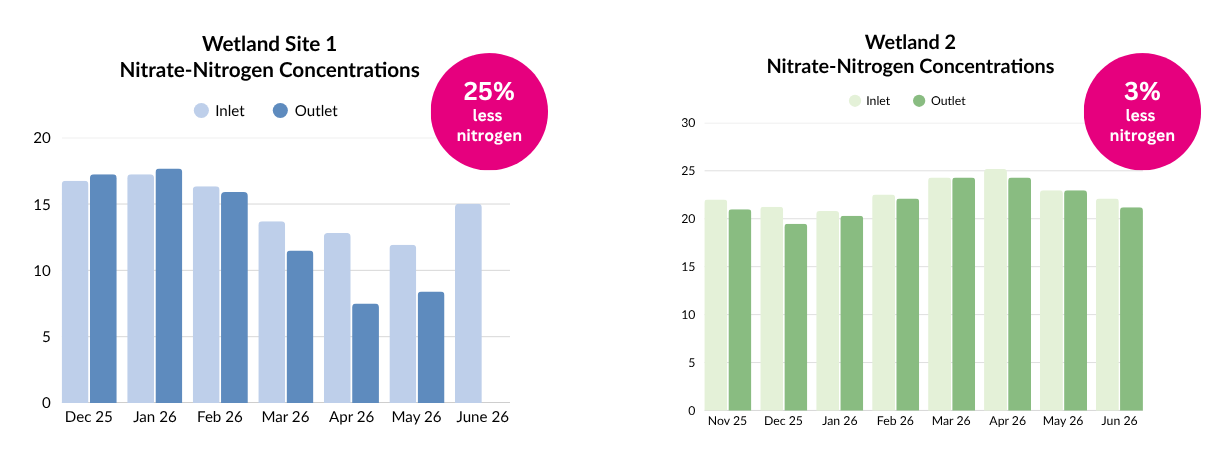
*Monitoring data derived from monthly inflow and outflow sampling undertaken between December 2025 and June 2026.